
The ‘false flag’ libel
When Jews Are Not Allowed To Be Victims

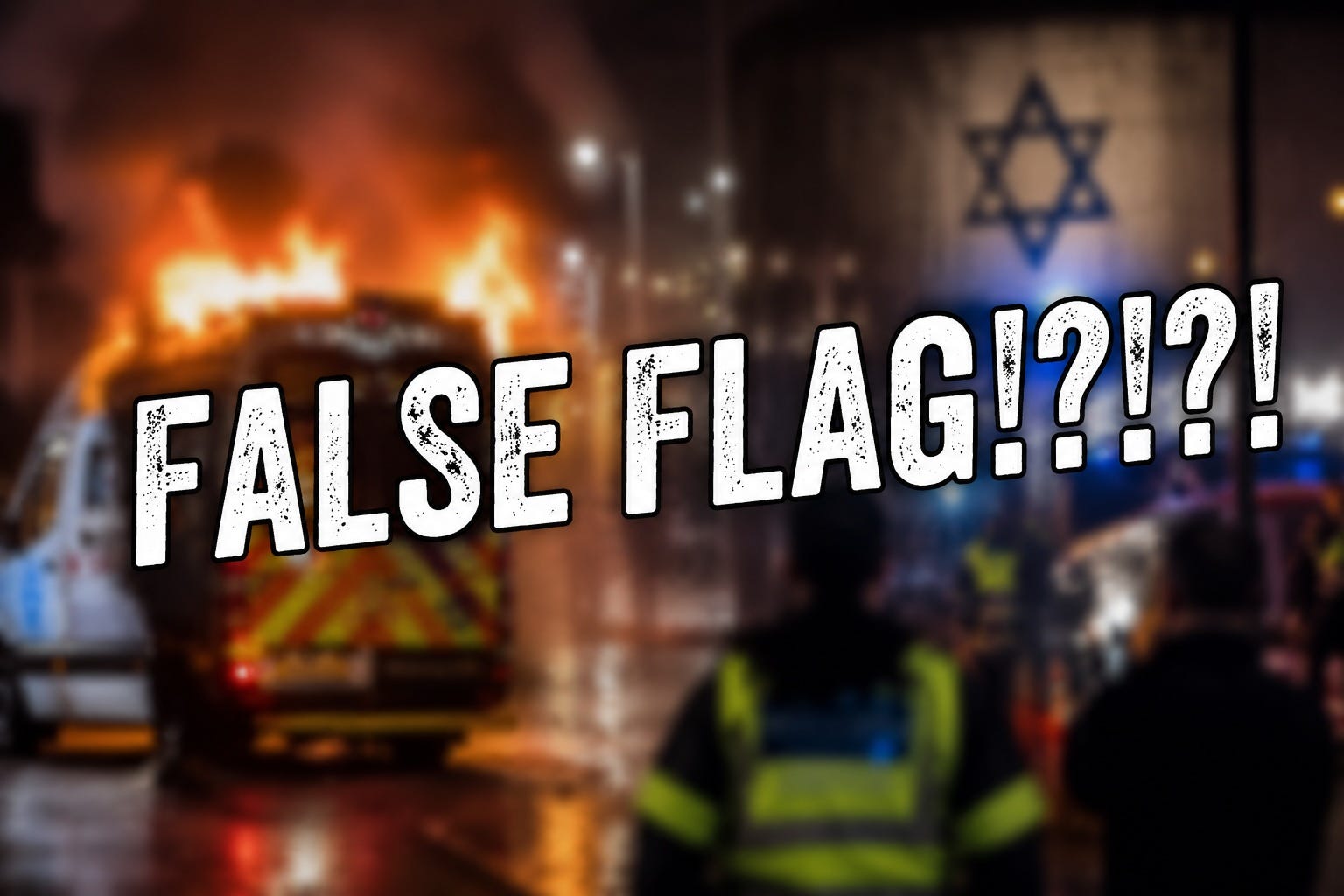
I am writing in mid-May 2026, when the spate of antisemitic attacks in the UK keeps rolling on.
Here are the physical attacks on people and property just in the past couple of months that I have found:
23 March 2026: Hatzola ambulance arson in Golders Green
15 April 2026: Finchley synagogue attempted firebombing
17 April 2026: Hendon Jewish charity premises arson
18 April 2026: Kenton synagogue arson
19 April 2026: Watford Jewish-owned shop arson
19 April 2026: Golders Green memorial wall arson
20 April 2026: Car driven at Jewish schoolboys in Barnet
20 April 2026: Planned arson attack on another Jewish community site reportedly foiled by police
29 April 2026: Golders Green stabbing attack on two Jewish men
5 May 2026: Former East London Central Synagogue arson attack in Whitechapel
9 May 2026: Enfield antisemitic assault causing minor injuries
11 May 2026: Clapton Common filmed antisemitic harassment attack targeting a Jewish man in Stamford Hill/Hackney area
One of the things all of these attacks seem to have in common is how masses of people on the internet react when these are reported.
Sections of the public find it easier to reach for conspiracy theories than to admit these crimes are happening. The continual refrain is often:
It was a false flag.
It was done by the Jews themselves to generate sympathy, money, security, political cover or support for Israel.
This happened after the Manchester synagogue attack on Yom Kippur 2025. The Institute for Strategic Dialogue recorded roughly 6,000 antisemitic posts from around 5,000 users in the days after the attack, including conspiracy theories claiming the attack was staged or otherwise manipulated.
It happened after the Hatzola ambulance arson in Golders Green, a 30-minute walk from my house, where Jewish volunteer ambulances were set on fire and the Mayor of Bath later resigned after sharing material that suggested the attack was a false flag.
It has happened often enough for the Blue Square Alliance to track false-flag conspiracy posts as a category of antisemitic online response, with a reported record high in early 2026.
False flags are real
States have staged provocations, fabricated pretexts and lied about violence when the political gain was large enough.
In May 1972, a car bomb in the village of Peteano in north-eastern Italy killed three Carabinieri. The attack was initially attributed to the left-wing Red Brigades. Later judicial inquiries identified the bombers as right-wing operatives connected to NATO’s Italian stay-behind network Operation Gladio, with elements of the Italian state implicated in the cover-up.
In September 1955, the bombing of Atatürk’s birthplace in Thessaloniki was used by Turkey as the pretext for the September 6-7 pogrom against Istanbul’s Greek minority. Later investigations established that the bomb had been placed by a Turkish state agent and that the pogrom itself had been organised in advance by the authorities, with several dozen people killed and the city’s Greek community largely driven out as a result.
The US Joint Chiefs of Staff drafted Operation Northwoods in 1962, proposing manufactured incidents, including attacks on American targets, to justify military action against Cuba; the plan was rejected and later declassified.
Israel belongs in this history too. The Lavon Affair was a failed 1954 Israeli covert operation in Egypt in which Egyptian Jews and undercover Israeli agents were used to bomb American, British and Egyptian targets, with the aim of blaming the attacks on Arabs and making the British withdrawal from the Suez Canal Zone harder.
Avi Shlaim, the Iraqi-born Oxford historian, has argued that Zionist underground operatives were involved in some of the 1950–51 Baghdad bombings against Jewish targets, though other historians dispute this here, history remains contested.
States lie. That much is on the record. The issue is how quickly one particular community is denied the ordinary presumption that an attack on it may be what it appears to be.
When fifty-one Muslims were murdered in Christchurch in March 2019, the mainstream response did not settle on the idea that Muslims had staged it. When 269 people were killed in the Sri Lankan Easter bombings the following month, Christians were not accused by default of having murdered themselves for sympathy. When ISIS attacked Yazidi villages, the victims were not treated as the secret authors of their own destruction. Attacks on Sikh gurdwaras, Hindu temples, Sufi shrines or Coptic churches do not reliably generate the same instant claim that the victims faked their own suffering.
The Israeli false-flag record is small, public and mostly historical. The online accusation rate does not track that record. It tracks something else.
This has a history.
The blood libel accused Jews of murdering Christian children for ritual purposes. The host-desecration libel accused Jews of stealing and abusing consecrated bread. Well-poisoning accusations during plague years cast Jews as secret authors of public catastrophe. These claims did not merely accuse Jews of doing terrible things. They trained Christian Europe to see Jewish vulnerability as suspect. When violence came for Jews, the surrounding culture already had a story ready: Jews had provoked it, arranged it, deserved it, or hidden the truth behind it.
The Protocols of the Elders of Zion modernised that suspicion. First published in Russia in the early twentieth century and exposed by The Times in 1921 as a plagiarised fraud, the Protocols pretended to reveal secret Jewish plans for global control. It recast visible Jewish life, including Jewish suffering, as surface activity hiding coordinated power underneath.
The modern false-flag line plugs into the same tradition of thought. It does not say merely that governments deceive. It says Jewish suffering can’t be trusted.
That is why evidence often fails to shift the claim.
In the Golders Green ambulance arson case, Hamza Iqbal, twenty, Rehan Khan, nineteen, a seventeen-year-old boy and Judex Atshatshi, eighteen, were charged in relation to the attack. The Crown Prosecution Service confirmed the charges, and the Met Police said the investigation was being led by Counter Terrorism Policing. AP reported that the attack was being investigated as an antisemitic hate crime and that police were examining a possible claim linked to a group with Iranian connections, while noting that the incident had not been formally classified as terrorism.
Those details should move the conversation away from conspiracy. They usually do not. The suspects are rendered as paid agents. CCTV footage must have been planted. Charges become part of the cover story. Each new fact is made to serve the conclusion that was already reached.
The problem with the false-flag claim is not only that it is usually made without evidence. It is that it cannot be disproved.
If no one has been arrested, that proves the police are hiding something. If someone has been arrested, that proves a patsy has been found. If there is CCTV, it was planted. If there is no CCTV, the footage has been suppressed. If the suspect is Muslim, he was recruited. If the suspect is white, he was selected. If the suspect is Jewish, the mask slips. If the suspect is not Jewish, the hand behind him must be.
Every fact enters the machine and comes out pointing in the same pre-determined direction.
That is why this is not really an argument about false flags. It is an argument about Jews. More precisely, it is an argument about whether Jews are allowed to describe harm done to them without being treated as suspects in their own victimhood.
The false-flag libel dresses itself up as scepticism, but it behaves like faith. Not religious faith, but rather something meaner: the certainty that Jewish suffering must have a hidden Jewish author.
Once someone believes that, evidence does not correct the belief. Evidence feeds it.
The accusation arrives quickly as it is not waiting for facts. It already knows what it came to say.